The quest for optimal restorative rest has driven extensive biomechanical research in early 2026, leading many individuals and sleep specialists to reevaluate traditional bedding setups. For centuries, head elevation has been a standard component of human sleep environments across various cultures. However, as our understanding of spinal health, neuromuscular recovery, and respiratory dynamics deepens, a fundamental question frequently emerges in clinical discussions: is pillow good for sleep? To answer this objectively, we must examine the physiological mechanics of the human body at rest, the exact function of cervical support, and the varying impacts of sleep positions on the spine.
In this comprehensive analysis, we explore the latest 2026 consensus on sleep ergonomics. We will investigate the biomechanical role of head support, evaluate whether a minimalist approach is beneficial, and dissect the physiological realities behind the ongoing debate regarding whether one should utilize head elevation for optimal health.
The Biomechanics of Rest and the Role of Head Elevation
The human spine naturally forms an ‘S’ shape when viewed from the side, consisting of the cervical lordosis (neck), thoracic kyphosis (mid-back), and lumbar lordosis (lower back). During waking hours, this curvature acts as a shock absorber for the central nervous system and supports the weight of the head, which averages between 10 to 12 pounds. When transitioning to a supine, prone, or lateral recumbent position for sleep, the gravitational forces acting on the musculoskeletal system shift dramatically.

Maintaining proper neck alignment when sleeping is the primary biological function of any head support. A pillow is engineered to fill the negative space between the head, neck, and the mattress, preventing the cervical spine from hyperextending backward or flexing too far forward. If this space is not adequately supported, the surrounding muscles, ligaments, and tendons must remain engaged to stabilize the cervical vertebrae, inhibiting the deep muscular paralysis (atonia) required for the deepest stages of rest.
How Different Positions Alter Alignment Needs
The necessity of a pillow is heavily dictated by an individual’s predominant sleeping position. Lateral (side) sleepers have a significant gap between the mattress and the side of their head, equal to the width of their shoulder. Back sleepers have a smaller gap, defined by the natural curve of the back of the skull and the cervical spine. Prone (stomach) sleepers have virtually no gap, and elevating the head in this position often forces the neck into an unnatural and strained extension.
| Sleep Position | Spinal Alignment Challenge | Pillow Requirement in 2026 Clinical Guidelines |
|---|---|---|
| Lateral (Side) | Shoulder width creates a large gap, risking lateral cervical flexion. | High necessity. A firm, thick support is required to keep the head level with the spine. |
| Supine (Back) | Gravity pulls the cervical curve flat against the mattress. | Moderate necessity. A thin, contouring support is ideal to cradle the neck without pushing the chin to the chest. |
| Prone (Stomach) | Head must be turned to breathe, causing cervical rotation and extension. | Low to zero necessity. Sleeping flat is highly recommended to avoid severe spinal torque. |
Is Sleeping Without a Pillow Good? The 2026 Perspective
As minimalist wellness trends continue to intersect with orthopedic science, many people wonder, is sleeping without a pillow good? The answer is nuanced and depends largely on the interplay between a sleeper’s mattress firmness, body morphology, and chosen sleep posture. From an evolutionary biology standpoint, early humans slept on natural terrains without engineered foams or down feathers. However, modern humans often sleep on highly engineered, yielding surfaces that alter the way the body’s weight is distributed.
For some, particularly prone sleepers, eliminating head elevation is not just acceptable; it is medically recommended by orthopedic specialists. When a stomach sleeper uses a pillow, their cervical spine is forced into a state of extreme backward extension and lateral rotation, which compresses the intervertebral discs and can pinch cervical nerve roots. In this specific scenario, evaluating whether is sleeping without pillow good results in a resounding yes. It flattens the upper body, allowing the spine to return to a more neutral, horizontal plane.
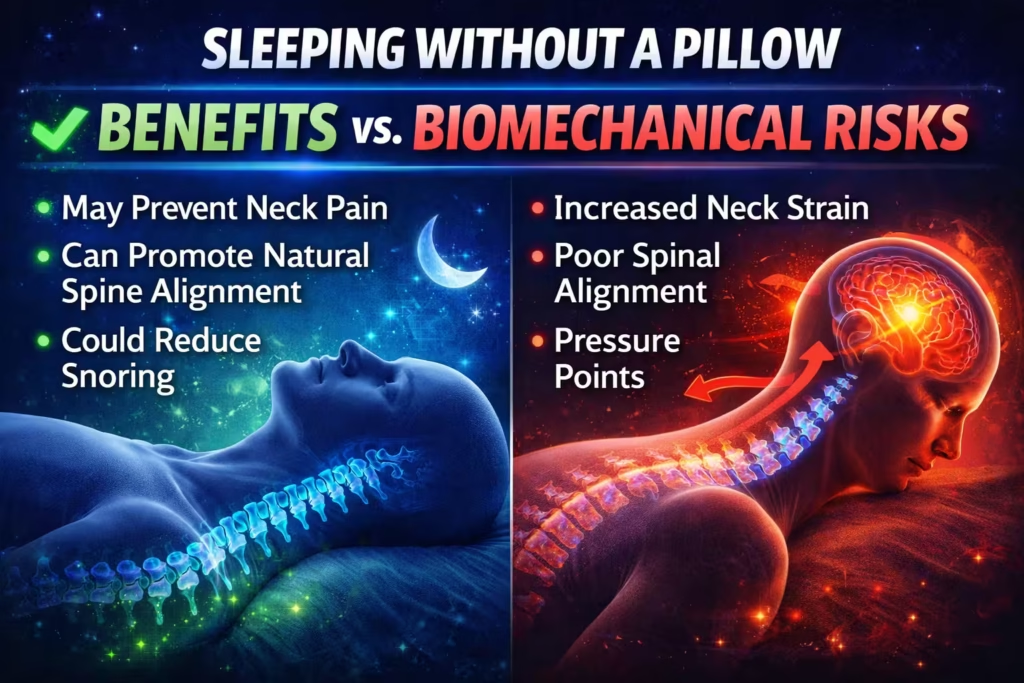
Sleeping Without a Pillow Benefits vs. Biomechanical Risks
When assessing the physiological impact of a pillowless sleep setup, researchers have documented several sleeping without a pillow benefits, particularly for specific demographics. However, this approach is not universally advantageous. Understanding the pros and cons is essential for anyone considering a change in their nightly routine.
The Documented Benefits
1. Reduction of Cervical Strain for Prone Sleepers: As previously mentioned, removing head elevation for stomach sleepers drastically reduces the severe angle of the neck, mitigating morning stiffness and the risk of developing chronic cervical radiculopathy.
2. Potential for Enhanced Facial Skin Health: Dermatological studies in 2026 note that minimizing the surface area pressing against the face reduces overnight fluid accumulation and material friction, which can lower the incidence of sleep-induced facial creasing.
3. Neutralization of the Airway in Specific Supine Sleepers: For individuals sleeping flat on your back on a properly supportive mattress, removing a thick pillow prevents the head from tilting too far forward. A forward head tilt can compress the trachea and exacerbate mild obstructive sleep apnea. By resting the head flat, the airway remains straight and unobstructed, provided the sleeper does not suffer from excessive base-of-tongue collapse.
Is It Bad to Sleep Without a Pillow?
Conversely, patients frequently ask, is it bad to sleep without a pillow? For side sleepers, it is definitively harmful. Without a pillow, a side sleeper’s head will collapse downward toward the mattress. This lateral flexion causes extreme tension on the upward-facing neck muscles (such as the upper trapezius and sternocleidomastoid) and compresses the downward-facing side. Over an eight-hour sleep cycle, this misalignment restricts blood flow, irritates the facet joints of the cervical spine, and frequently leads to tension headaches and severe musculoskeletal pain upon waking.
| Biomechanical Factor | Effect of Using a Pillow | Effect of Removing the Pillow |
|---|---|---|
| Cervical Lordosis (Back Sleepers) | Supports natural curve if properly sized; causes hyper-flexion if too thick. | May flatten the curve excessively on firm mattresses, leading to strain. |
| Thoracic Alignment (Side Sleepers) | Maintains straight horizontal axis from neck to mid-back. | Causes immediate lateral drop, stressing the thoracic and cervical joints. |
| Tracheal Patency (Airway) | Keeps airway open if contoured; restricts airway if chin is pushed to chest. | Straightens airway naturally, but may allow tongue to fall back due to gravity. |
Does Sleeping Without a Pillow Help Posture?
The relationship between nighttime ergonomics and daytime posture is a focal point of 2026 orthopedic research. Does sleeping without a pillow help posture? The hypothesis is that a firm, flat sleeping environment forces the spine to recalibrate and stretch out the muscular tightness accumulated from hours of sitting hunched over digital devices. Conditions like ‘tech neck’ (forward head posture) are characterized by shortened, tight anterior neck muscles and weakened posterior neck muscles.
For individuals sleeping flat on your back, eliminating a pillow can act as a passive stretch. Gravity gently pulls the shoulders back into the mattress and encourages the cervical spine to retract from its daytime forward-leaning position. However, this only improves posture if the mattress itself provides adequate pelvic and lumbar support. If the mattress is too soft, the heavier pelvic region will sink, effectively destroying spinal neutrality regardless of what is happening at the head and neck. Therefore, while sleeping without a pillow can facilitate passive postural correction for back sleepers, it is only one variable in a complex biomechanical equation.
The Anatomy of Sleeping Flat on Your Back
Sleeping flat on your back, technically known as the supine position, is widely considered by 2026 medical professionals to be the most anatomically neutral position for the human body, provided the limbs are kept relatively symmetrical. When you sleep supine, gravity distributes your body weight evenly across the widest surface area possible, minimizing localized pressure points on the hips and shoulders.
When attempting this position without a pillow, the occiput (the back of the skull) rests directly on the sleep surface. For individuals with a pronounced natural cervical curve, this can create a sensation of the head dropping backward (cervical extension). To combat this while still maintaining a minimalist setup, some sleep specialists recommend placing a tightly rolled towel directly under the hollow of the neck, rather than elevating the entire head. This targets the necessary proper neck alignment when sleeping without pushing the skull out of alignment with the thoracic spine.
Tracking Your Sleep Alignment Adjustments
Any modification to your sleep environment, such as removing a pillow or changing your primary sleep position, will inevitably impact your sleep architecture. In 2026, the use of biometric wearables has made it possible to objectively measure how ergonomic changes affect physiological recovery. For example, if poor neck alignment is causing micro-arousals (brief awakenings that pull you out of restorative sleep), transitioning to a better alignment should theoretically increase your continuous deep sleep metrics.
Understanding how to interpret this data is critical for self-experimentation. If you decide to test sleeping without a pillow, monitor your biometric feedback over a two-week period. To thoroughly understand the data your wearable provides, you can review our detailed breakdown on Are Sleep Trackers Accurate for Deep Sleep? A 2026 Comprehensive Analysis. Furthermore, comprehending the exact sensors—such as photoplethysmography and accelerometers—used to detect autonomic nervous system changes during these ergonomic shifts is vital. For a deeper dive into this technology, explore How Do Sleep Trackers Measure Deep Sleep? The Science Behind Wearable Technology. By leveraging data, individuals can move past subjective feelings of restfulness and objectively determine if their new alignment strategy is succeeding.
Clinical Guidelines from Approved Health Organizations
Major health organizations continue to research the optimal parameters for sleep hygiene. According to guidance derived from data by the National Heart, Lung, and Blood Institute (NHLBI) and public health resources like the Sleep Foundation, sleep environments must be individualized. The consensus in 2026 maintains that there is no one-size-fits-all approach to bedding.
Clinical studies accessible via PubMed consistently highlight that cervical spine support must be proportional to a person’s biometric measurements. A broad-shouldered side sleeper requires significantly more loft than a petite back sleeper. The overarching clinical advice is to aim for a sleep posture where the ears, shoulders, and hips are aligned as they would be if you were standing with perfect posture.
| Body Type & Sleep Position | 2026 Ergonomic Pillow Recommendation | Primary Clinical Objective |
|---|---|---|
| Petite / Back Sleeper | Ultra-thin or no pillow (with neck roll) | Prevent forward head translation and airway compression. |
| Broad Shoulders / Side Sleeper | Firm, high-loft pillow with gussets | Prevent lateral cervical collapse and nerve impingement. |
| Any Body Type / Stomach Sleeper | No pillow under head; thin pillow under pelvis | Reduce extreme cervical rotation and support lumbar spine. |
| Mixed / Combination Sleeper | Shredded memory foam or adjustable loft | Allow material displacement to accommodate position changes. |
Conclusion: Finding Your Optimal Alignment
Returning to the core inquiry: is pillow good for sleep? Biomechanically, a pillow is a tool designed to solve a specific problem—the anatomical gap between the head and the mattress. If your sleep position naturally creates a large gap (side sleeping), a pillow is strictly necessary for your health. If your sleep position creates little to no gap (stomach sleeping), a pillow is detrimental. For back sleepers, the requirement falls somewhere in the middle, heavily reliant on the mattress’s rigidity and the individual’s spinal curvature.
Ultimately, achieving restorative sleep relies on achieving sustained muscular relaxation. Whether that involves a high-tech contoured memory foam support, a simple cervical roll, or sleeping entirely flat on your back without any head elevation, the goal remains the same: neutral spinal alignment that allows the central nervous system to recover uninterrupted.
2026 Educational and Medical Disclaimer
The information provided in this article is for educational and informational purposes only and reflects the scientific and biomechanical consensus available in early 2026. It does not constitute medical advice, diagnosis, or treatment. Sleep ergonomics and spinal health are highly individualized. Individuals suffering from chronic neck pain, sleep apnea, spinal stenosis, or other musculoskeletal conditions should consult with a board-certified orthopedic specialist, physical therapist, or sleep medicine physician before making significant alterations to their sleep environment or posture.
Frequently Asked Questions (FAQs)
1. Is pillow good for sleep every night?
Yes, for the vast majority of people, especially side and back sleepers, using an appropriately sized pillow every night is vital. It maintains the natural curvature of the cervical spine, prevents muscle strain, and supports unobstructed breathing during the deep stages of sleep.
2. Is sleeping without a pillow good for neck pain?
It depends strictly on your sleep position. If you are a stomach sleeper experiencing neck pain, removing the pillow can significantly reduce cervical extension and alleviate discomfort. However, if you are a side sleeper with neck pain, removing the pillow will likely exacerbate the problem by forcing the neck into extreme lateral flexion.
3. Does sleeping without a pillow help posture over time?
For individuals who sleep flat on their back, removing a thick pillow can act as a passive stretch for the anterior neck muscles, potentially aiding in the correction of forward head posture (tech neck). However, this must be combined with daytime postural exercises to yield significant long-term structural changes.
4. Is it bad to sleep without a pillow if I am a side sleeper?
Yes, from a biomechanical standpoint, it is highly detrimental. A side sleeper requires a support structure equal to the distance between their ear and the edge of their shoulder. Sleeping without one forces the head to collapse downward, straining the intervertebral discs and soft tissues of the neck.
5. What are the main sleeping without a pillow benefits?
The primary benefits are experienced by stomach sleepers, who see a reduction in extreme spinal extension and rotation. Secondary benefits reported include a potential decrease in facial skin creasing and a reduction in airway compression for back sleepers who were previously using overly thick, chin-tucking pillows.
6. How can I ensure proper neck alignment when sleeping?
Proper alignment is achieved when your spine maintains a straight, horizontal line from your head to your tailbone while on your side, or maintains its natural curves without hyperextension when on your back. Having a partner observe your posture, or taking a photograph of your sleeping profile, can help assess if your head is tilting up or sagging down.
7. Is sleeping flat on your back the healthiest position?
Orthopedic specialists widely consider supine sleeping to be the most anatomically neutral position, as it evenly distributes body weight and minimizes pressure points. It is excellent for spinal health, though it can exacerbate snoring and sleep apnea in individuals prone to airway collapse.
8. Can removing my pillow affect deep sleep?
Yes. Any change in spinal alignment can alter comfort levels. If removing the pillow improves your alignment (e.g., for a stomach sleeper), it will reduce muscle tension and micro-arousals, thereby increasing the duration and quality of deep, slow-wave sleep. Conversely, if it creates pain, deep sleep will fragment.
9. How long does it take to adjust to sleeping without a pillow?
Neuromuscular adaptation varies, but it typically takes the body 7 to 14 days to adjust to a new sleeping posture or environment. During this transition, it is normal to experience transient stiffness as the muscles acclimate to supporting the spine differently.
10. Do sleep specialists in 2026 recommend pillows for stomach sleepers?
No. The 2026 clinical consensus strongly advises stomach sleepers to forego a traditional head pillow to prevent severe cervical torque. Instead, specialists often recommend placing a thin pillow beneath the pelvis or lower abdomen to prevent the lumbar spine from hyper-extending downward into the mattress.
References
- National Heart, Lung, and Blood Institute (NHLBI). (2026). Sleep Science and Health Dynamics. Retrieved from https://www.nhlbi.nih.gov/health/sleep
- Sleep Foundation. (2026). Sleeping Without a Pillow: Benefits, Risks, and Alignment. Retrieved from https://www.sleepfoundation.org/bedding-information/sleeping-without-a-pillow
- National Institutes of Health (NIH). (2026). Brain Basics: Understanding Sleep Architecture and Biomechanics. Retrieved from https://www.ninds.nih.gov/health-information/public-education/brain-basics/brain-basics-understanding-sleep
- PubMed / National Center for Biotechnology Information. (2026). Cervical Spine Kinematics During Supine and Lateral Sleep Positions. Retrieved from https://pubmed.ncbi.nlm.nih.gov/