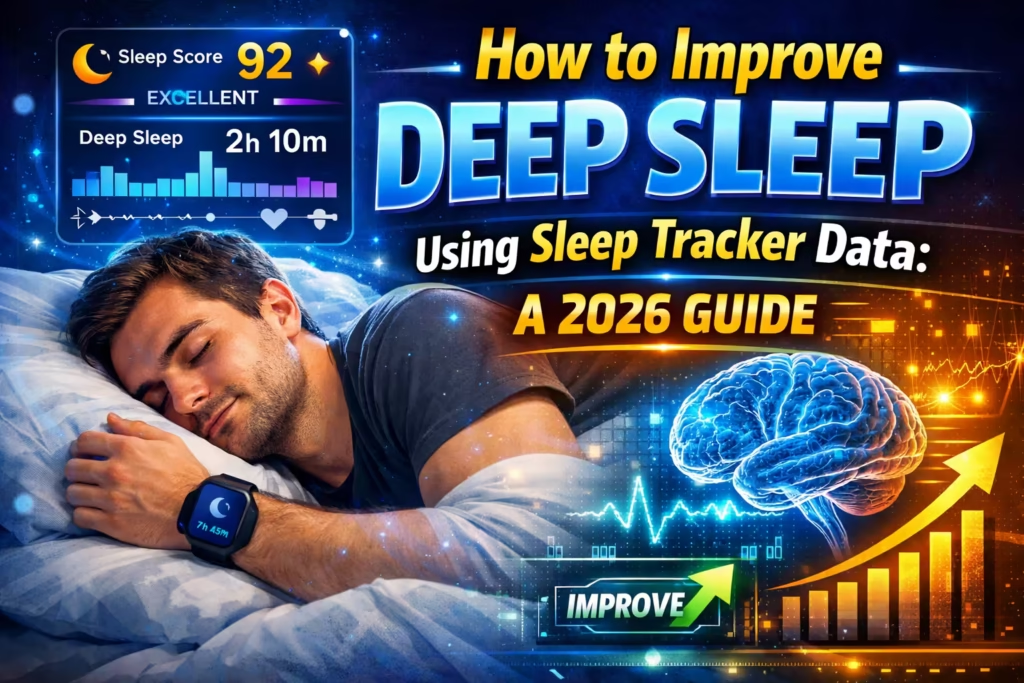
In the landscape of modern health, understanding the nuances of restorative rest is critical. For individuals seeking to optimize their physical and cognitive recovery, learning how to improve deep sleep using sleep tracker data has become a foundational pillar of modern wellness. Wearable technology in 2026 has advanced far beyond simple step counting; today’s devices capture complex biometric data, offering profound sleep tracker insights into the most restorative phases of our nightly cycles.
Deep sleep, scientifically referred to as slow-wave sleep (SWS) or NREM Stage 3, is the period when the body engages in cellular repair, memory consolidation, and immune system fortification. However, simply wearing a device is not enough. True sleep cycle optimization requires the ability to analyze sleep data, recognize baseline deviations, and implement evidence-based behavioral and environmental modifications.
Understanding Deep Sleep Stages and Delta Wave Tracking
Before making any changes, it is essential to understand the biological mechanisms of the deep sleep stages. During slow-wave sleep, brain activity slows down significantly, producing high-amplitude, low-frequency electrical patterns known as delta waves. Delta wave tracking, historically confined to polysomnography in clinical sleep labs, is now probabilistically modeled by modern wearables using a combination of photoplethysmography (PPG) sensors, accelerometers, and thermal sensors.
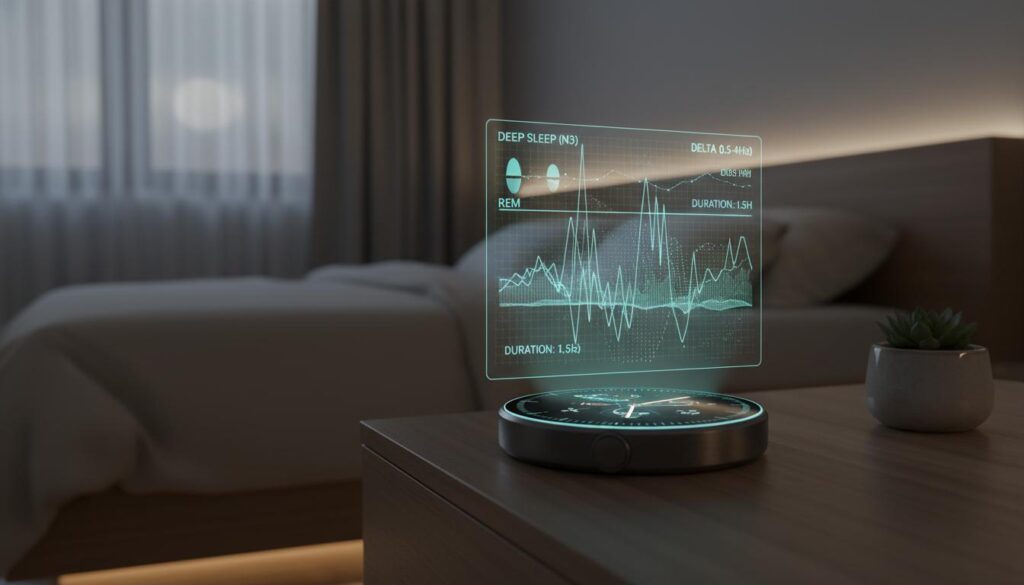
For a deeper understanding of the technology capturing this data, you can read our detailed breakdown on How Do Sleep Trackers Measure Deep Sleep? The Science Behind Wearable Technology. When you track REM deep sleep and light sleep, you are observing an algorithmic estimation based on your autonomic nervous system’s behavior. Deep sleep typically accounts for 15% to 25% of a healthy adult’s total sleep time, predominantly occurring in the first half of the night.
Step 1: Analyze Sleep Data to Identify Low Deep Sleep
The first step in any intervention is to identify low deep sleep through consistent sleep pattern analysis. When you analyze sleep data over a continuous 14-day period, you establish a personal baseline. Do not hyper-focus on a single night’s data; instead, look for longitudinal trends. If your wearable consistently reports slow-wave sleep falling below the 15% threshold of your total sleep time, it may indicate fragmented sleep architecture.
Clinical guidelines established by institutions like the Sleep Foundation suggest that age plays a significant role in deep sleep duration. As humans age, the amplitude of delta waves naturally decreases. Therefore, it is vital to benchmark your data against age-appropriate norms.
Table 1: 2026 Clinical Baselines for Deep Sleep by Age Bracket
| Age Group | Average Total Sleep Time | Optimal Deep Sleep Percentage | Average Deep Sleep Duration |
|---|---|---|---|
| 18 – 25 Years | 7.5 – 9 Hours | 20% – 25% | 90 – 120 Minutes |
| 26 – 45 Years | 7 – 8.5 Hours | 18% – 22% | 80 – 100 Minutes |
| 46 – 64 Years | 7 – 8 Hours | 15% – 18% | 60 – 85 Minutes |
| 65+ Years | 7 – 8 Hours | 10% – 15% | 45 – 70 Minutes |
By comparing your wearable’s output to these clinical averages, you can accurately identify low deep sleep and determine the urgency of your interventions.
Step 2: Monitor Heart Rate Sleep Metrics to Improve HRV
Modern sleep pattern analysis relies heavily on cardiovascular metrics. Two of the most critical data points provided by your tracker are resting heart rate (RHR) and Heart Rate Variability (HRV). During restorative deep sleep, your cardiovascular system should experience a state of profound relaxation. Your resting heart rate should dip to its lowest point of the 24-hour cycle, a phenomenon known as nocturnal dipping.
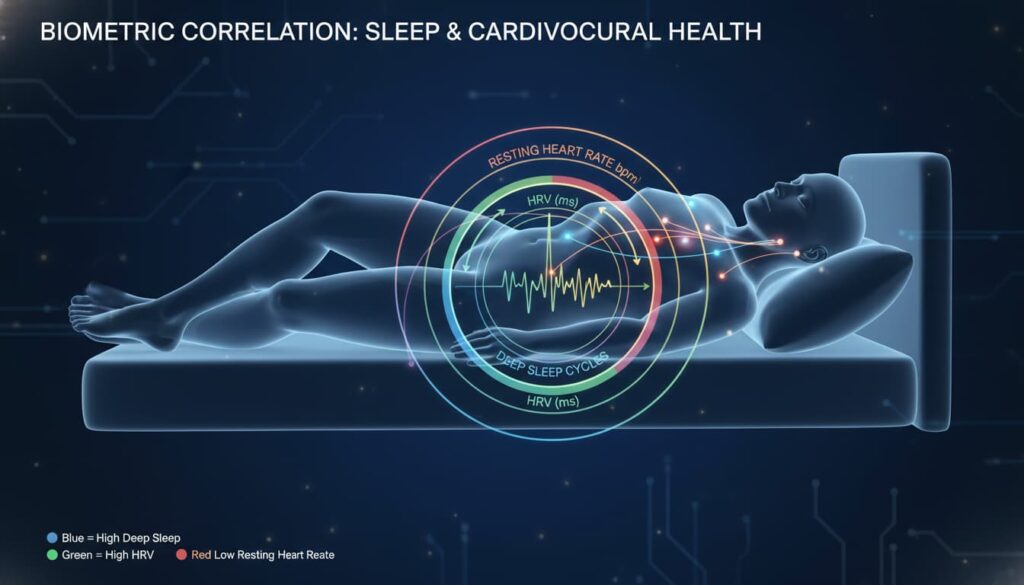
Heart Rate Variability (HRV) measures the time variance between consecutive heartbeats, reflecting the balance between your sympathetic (fight-or-flight) and parasympathetic (rest-and-digest) nervous systems. High HRV during sleep indicates robust autonomic resilience and a dominant parasympathetic state, which is necessary to boost deep sleep.
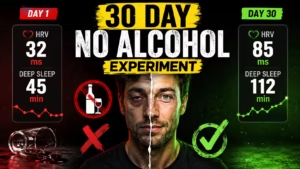
If your tracker indicates a high heart rate sleep profile or low HRV, it often means your body is processing physiological stress. To improve HRV, experts recommend focusing on stress-reduction techniques before bed, optimizing your diet, and managing training loads. Elevated nocturnal heart rates are frequently linked to late heavy meals, alcohol consumption, or latent psychological stress, all of which inhibit the brain’s ability to descend into delta-wave sleep.
Step 3: Implement Sleep Environment Tweaks
Your bedroom environment dictates the quality of your rest. Thermoregulation is intrinsically tied to the circadian rhythm. As bedtime approaches, the body’s core temperature must drop by approximately 1 to 2 degrees Fahrenheit to initiate and sustain deep sleep. If you want to know how to improve deep sleep using sleep tracker data, one of the most immediate actions you can take is to adjust temperature settings in your bedroom.
Data from the National Institutes of Health (NIH) highlights that ambient room temperature is one of the most critical factors in sleep architecture. Creating a cooler bedroom sleep environment—typically between 60 to 67 degrees Fahrenheit (15 to 19 degrees Celsius)—facilitates this core temperature drop. Many 2026 sleep trackers monitor nocturnal skin temperature. If your wearable shows temperature spikes during the night, it is a clear signal to adjust temperature using breathable bedding, cooling mattress pads, or thermostat scheduling.
Additionally, auditory environments impact brainwave states. While sudden noises can pull you out of slow-wave sleep, continuous acoustic masking can protect it. Using a sound machine deep sleep setting, particularly one that emits pink noise, has been shown in clinical studies to enhance the amplitude of slow oscillations, thereby fortifying deep sleep.
Table 2: Environmental Factors and Wearable Data Indicators
| Environmental Factor | Impact on Sleep Architecture | Tracker Data Indicator | Correction Strategy |
|---|---|---|---|
| High Ambient Temperature | Delays onset of slow-wave sleep, increases wake events. | Elevated skin temperature, high resting heart rate. | Adjust temperature to 60-67 F, use cooling fabrics. |
| Inconsistent Noise | Triggers micro-arousals, shifts sleep to lighter stages. | Frequent awakenings, fragmented sleep graphs. | Utilize a sound machine deep sleep setting (pink noise). |
| Light Exposure (Blue Light) | Suppresses melatonin secretion, delaying deep sleep. | Delayed sleep onset, shifted circadian rhythm. | Install blackout curtains, use amber lighting pre-bed. |
Step 4: Execute Lifestyle Tweaks for Sleep Cycle Optimization
Wearable sleep tips frequently emphasize that daytime behaviors dictate nighttime recovery. Through careful analysis of your tracker data, you can implement targeted lifestyle tweaks to improve sleep quality. One of the most common insights gained from analyzing continuous data is the importance of a consistent sleep schedule. Going to bed and waking up at the exact same time every day anchors the circadian rhythm, allowing the brain to efficiently anticipate and enter deep sleep stages.
Furthermore, earlier bedtime data often correlates with higher deep sleep percentages. Because slow-wave sleep is heavily concentrated in the first third of the night, delaying your bedtime past your natural circadian dip can cause you to miss this vital recovery window.
Other critical lifestyle tweaks include:
- Avoid Caffeine Sleep Disruption: Caffeine has a half-life of up to six hours. Consuming it late in the day binds adenosine receptors, masking sleep pressure. Tracker data will often show a prolonged time to fall asleep and reduced delta wave tracking if caffeine is consumed too late. Ensure you avoid caffeine sleep disruptions by cutting off intake 10 to 12 hours before bed.
- Exercise Timing Sleep Impact: Regular aerobic and resistance training are proven to boost deep sleep. However, vigorous exercise timing sleep interactions are complex. Exercising too close to bedtime raises core body temperature and cortisol levels, which can delay the onset of SWS. Aim to complete intense workouts at least three hours before your pre-bed routine.
- Optimizing the Pre-Bed Routine: A structured wind-down period signals to the brain that it is time to transition into a parasympathetic state. Incorporate reading, light stretching, or meditation into your pre-bed routine to systematically lower your resting heart rate before your head hits the pillow.
Step 5: When to Upgrade Tracker for Advanced Data
As biometric technology rapidly evolves, utilizing an outdated device can lead to inaccurate conclusions. If your current device relies solely on basic accelerometry rather than advanced PPG optical sensors and thermal arrays, it may be time to upgrade tracker hardware. In 2026, state-of-the-art wearables offer highly granular data, distinguishing between REM and NREM stages with clinical-grade precision.
When deciding whether to upgrade tracker capabilities, consider the specific sensors required for comprehensive sleep cycle optimization. Modern devices incorporate blood oxygen (SpO2) monitoring, continuous HRV tracking, and precise nocturnal temperature variations. To explore whether modern devices meet clinical standards, review our comprehensive analysis: Are Sleep Trackers Accurate for Deep Sleep? A 2026 Comprehensive Analysis.
Table 3: Troubleshooting Tracker Data Irregularities
| Data Irregularity Observed | Potential Physiological Cause | Recommended Action or Tweak |
|---|---|---|
| Consistently Low HRV | Overtraining, high stress, or late-night eating. | Improve HRV via stress management and earlier dinners. |
| High Nocturnal Heart Rate | Alcohol consumption, late exercise, or fever. | Avoid alcohol, adjust exercise timing sleep protocols. |
| Low Deep Sleep but High Total Sleep | Poor thermoregulation or sleep apnea symptoms. | Adjust temperature, consult a doctor if snoring persists. |
| No REM or Deep Sleep Registered | Sensor malfunction or outdated hardware. | Clean device sensors or upgrade tracker to a 2026 model. |
Track REM Deep: Balancing the Full Sleep Cycle
While the focus is often on slow-wave restorative rest, true sleep cycle optimization requires a holistic approach. It is vital to track REM deep sleep simultaneously. REM (Rapid Eye Movement) sleep is crucial for cognitive function, emotional regulation, and memory processing. The interplay between physical recovery in deep sleep and mental recovery in REM sleep constitutes the foundation of overall wellness. Wearable sleep tips often suggest that while deep sleep dominates the first half of the night, REM dominates the second. Therefore, ensuring adequate total sleep duration is non-negotiable for capturing both critical phases.
Frequently Asked Questions
1. How accurate is delta wave tracking on 2026 consumer sleep trackers?
While consumer wearables cannot directly measure brainwaves like a clinical EEG, 2026 devices use highly sophisticated algorithms combining autonomic nervous system data (HRV, heart rate, respiration, and temperature) to estimate delta wave tracking and deep sleep stages with an accuracy rate often exceeding 85% compared to clinical polysomnography.
2. Why does my sleep tracker indicate I get very little deep sleep?
If you identify low deep sleep on your tracker, it could be due to late caffeine consumption, elevated bedroom temperatures, high stress, or an inconsistent sleep schedule. It may also simply be a normal age-related decrease, which is why it is important to benchmark against age-specific data.
3. How can I improve HRV to boost my deep sleep metrics?
To improve HRV, focus on activating the parasympathetic nervous system before bed. This includes maintaining a consistent pre-bed routine, engaging in slow-paced breathing exercises, avoiding late-night alcohol, and ensuring your resting heart rate has time to lower before sleep.
4. What is the ideal temperature for a cooler bedroom sleep environment?
Clinical guidelines consistently recommend keeping the bedroom between 60 and 67 degrees Fahrenheit. This range helps facilitate the necessary drop in your body’s core temperature required to initiate and maintain restorative deep sleep.
5. Does the timing of my exercise affect my sleep data?
Yes, exercise timing sleep interactions are significant. While regular exercise promotes deeper sleep, engaging in high-intensity workouts within three hours of bedtime can elevate your core temperature and resting heart rate, delaying the onset of slow-wave sleep.
6. Should I use a sound machine to help me achieve deep sleep?
Using a sound machine deep sleep setting, particularly those utilizing pink noise, has been scientifically shown to enhance the slow oscillations of brainwaves during NREM Stage 3. It also provides acoustic masking against disruptive background noises.
7. How does alcohol affect heart rate sleep metrics?
Alcohol severely disrupts sleep architecture. While it may act as a sedative to help you fall asleep faster, it causes a significant spike in resting heart rate and plummets HRV, completely fragmenting deep sleep stages and preventing restorative recovery.
8. When is it necessary to upgrade my sleep tracker?
You should consider an upgrade tracker scenario if your current device is over three years old, lacks continuous optical heart rate sensors, does not track HRV, or fails to provide temperature metrics. 2026 devices offer a much clearer picture for accurate sleep pattern analysis.
References & Sources
- National Institutes of Health (NIH). Brain Basics: Understanding Sleep. Retrieved from https://www.ninds.nih.gov/health-information/public-education/brain-basics/brain-basics-understanding-sleep
- Centers for Disease Control and Prevention (CDC). Sleep and Sleep Disorders. Retrieved from https://www.cdc.gov/sleep/index.html
- Sleep Foundation. Deep Sleep: What It Is and How Much You Need. Retrieved from https://www.sleepfoundation.org/stages-of-sleep/deep-sleep
- National Heart, Lung, and Blood Institute (NHLBI). Sleep Deprivation and Deficiency. Retrieved from https://www.nhlbi.nih.gov/health/sleep-deprivation
- PubMed Central (PMC). The role of slow-wave sleep in memory consolidation and recovery. Retrieved from https://pubmed.ncbi.nlm.nih.gov/
Medical Review & Expert Insight: This comprehensive guide reflects clinical sleep medicine research and biometric wearable technology standards as of early 2026.
Disclaimer: This content is for informational and educational purposes only, reflecting the clinical landscape of early 2026. It is not a substitute for professional medical advice, diagnosis, or treatment. Consult a healthcare provider for persistent sleep disturbances.