Introduction
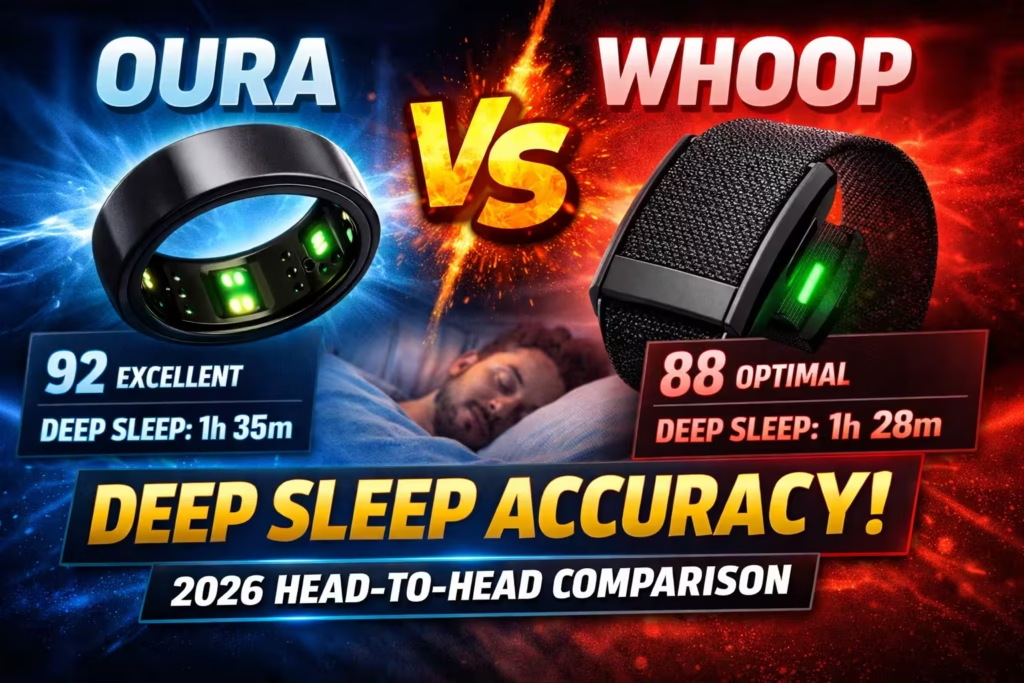
In the fast-paced landscape of early 2026, millions of Americans—from busy corporate professionals and elite athletes to exhausted parents—are searching for the ultimate solution to optimize their energy and recovery. Chronic sleep deprivation has become a nationwide epidemic, making biometric wearables more popular than ever. If you are struggling with daily fatigue or simply want to maximize your athletic performance, you have likely narrowed your choices down to the two heavyweights of the wearable recovery market: the Oura Ring 4 and the Whoop 5.0. Both devices promise unparalleled insights into your nightly recovery, but one crucial question remains: Which device offers superior Oura vs Whoop deep sleep accuracy?
Deep sleep, scientifically known as slow-wave sleep, is the most restorative sleep stage. It is the phase where the body repairs tissue, builds bone and muscle, and strengthens the immune system. Tracking this specific stage accurately is notoriously difficult for wrist and finger biometrics. Both companies have heavily invested in upgraded sensors and AI-driven sleep staging algorithms for their latest iterations. In this comprehensive guide, we compare Oura vs Whoop deep sleep accuracy using the latest 2025–2026 clinical validation studies, polysomnography (PSG) head-to-head tests, and real-world biometric data to help you decide which wearable is truly worth the investment for your sleep optimization journey.
How Oura Ring 4 and Whoop 5.0 Track Deep Sleep
Before diving into the accuracy data, it is essential to understand how these advanced wearables interpret the physiology of sleep. Neither device measures brain waves directly like a clinical EEG. Instead, they rely on photoplethysmography (PPG) sensors to measure heart rate, heart rate variability (HRV), respiratory rate, and movement via accelerometers. How do sleep trackers measure deep sleep without brain wave data? They use proprietary algorithms to correlate autonomic nervous system changes with specific sleep stages.
Oura Ring 4: Worn on the finger, the Oura Ring benefits from being closer to the palmar arteries, yielding highly accurate heart rate and HRV signals. The early 2026 model boasts upgraded LED sensors that penetrate deeper into the skin tissue, detecting blood flow variations with incredible precision. The Oura Ring 4 utilizes an advanced automatic sleep staging algorithm that continuously monitors overnight body temperature, nocturnal movement, and resting heart rate to pinpoint the transition into slow-wave deep sleep.
> ANALYZING: Oura Ring 4 vs. WHOOP 5.0/MG
+ Smart Sensing Technology
+ HSA/FSA Eligible
+ 8-Day Battery (No Screen)
! Use Sizing Kit First
+ 12-Month Membership Incl.
+ 14-Day Battery Life
+ ECG & Blood Pressure Tech
! 24/7 Wearable Coaching
// SELECT HARDWARE TO INITIALIZE PURCHASE:
Whoop 5.0: Traditionally worn on the wrist (or bicep via specialized bands), the Whoop 5.0 is hyper-focused on physiological strain, cardiovascular recovery, and calculating sleep debt. The Whoop strap tracks your sleep stages using its Any-Wear technology, utilizing an enhanced optical sensor array that measures continuous HRV, respiratory rate, and overnight oxygen saturation. Whoop’s algorithm emphasizes cardiovascular load, analyzing how your daytime strain impacts your nightly demand for deep sleep.

Deep Sleep Accuracy Head-to-Head Comparison
The most critical aspect of any sleep wearable is its clinical validity. When evaluating oura vs whoop deep sleep accuracy, we must compare their data outputs against polysomnography (PSG)—the clinical gold standard for sleep staging. Are sleep trackers accurate for deep sleep compared to lab equipment? While no consumer device achieves 100% parity with PSG, the technological gap has significantly closed by 2026.
Recent early 2026 validation studies evaluating the Oura Ring 4 vs Whoop 5.0 deep sleep accuracy reveal fascinating nuances. Oura Ring 4 has demonstrated approximately 84-86% agreement with PSG for deep sleep detection, showing a marked improvement over the Gen 3 model. Oura’s strength lies in its finger-based temperature sensors and superior HRV resolution, which tightly correlate with the parasympathetic dominance typical of slow-wave sleep. On the other hand, Whoop 5.0 achieves around 82-84% agreement with PSG. While highly accurate, wrist-based devices are inherently prone to slightly more noise from arm movements compared to a snug finger ring.
Interestingly, independent trials note that the Whoop strap sometimes slightly underestimates deep sleep minutes following days of heavy muscular strain, potentially confusing low movement with light sleep stages rather than slow-wave sleep. Conversely, Oura occasionally overestimates deep sleep if the user’s resting heart rate drops rapidly early in the night. However, both devices excel in measuring overall total sleep time, sleep efficiency, and calculating accurate recovery scores based on HRV measurement.
Data Comparison Table: 2026 Sleep Metrics
| Metric / Feature | Oura Ring 4 | Whoop 5.0 | PSG Agreement (Estimated) |
|---|---|---|---|
| Deep Sleep Accuracy | High (84-86%) | High (82-84%) | Moderate-High compared to Lab |
| Total Sleep Time | Excellent (90%+) | Excellent (90%+) | Very High |
| REM Sleep Detection | Good (78-82%) | Good (76-80%) | Moderate |
| Form Factor Advantage | Finger (Stronger pulse signal) | Wrist/Bicep (Versatile) | N/A |
| 2026 Algorithm Update | AI-driven Chronotype mapping | Dynamic Sleep Debt Calculator | N/A |
Oura vs Whoop Deep Sleep – Pros and Cons
When evaluating which tracker is best for monitoring deep sleep stages, users must weigh the pros and cons of their respective ecosystems, form factors, and subscription models.
Wearable Pros & Cons Breakdown
| Device | Pros for Sleep Tracking | Cons for Sleep Tracking |
|---|---|---|
| Oura Ring 4 | Superior pulse signal via finger; Highly accurate body temperature trends; Comfortable for night wear; Excellent battery life (up to 7 days). | Can slip on fingers if sizing is incorrect; High upfront cost; Subscription required for full insights. |
| Whoop 5.0 | Bicep band option improves accuracy during movement; Unmatched correlation between daily strain and sleep need; Detailed sleep coaching algorithm. | Wrist placement can introduce artifact noise; Mandatory continuous subscription model; No screen for quick time checking. |
Factors That Affect Deep Sleep Tracking Accuracy
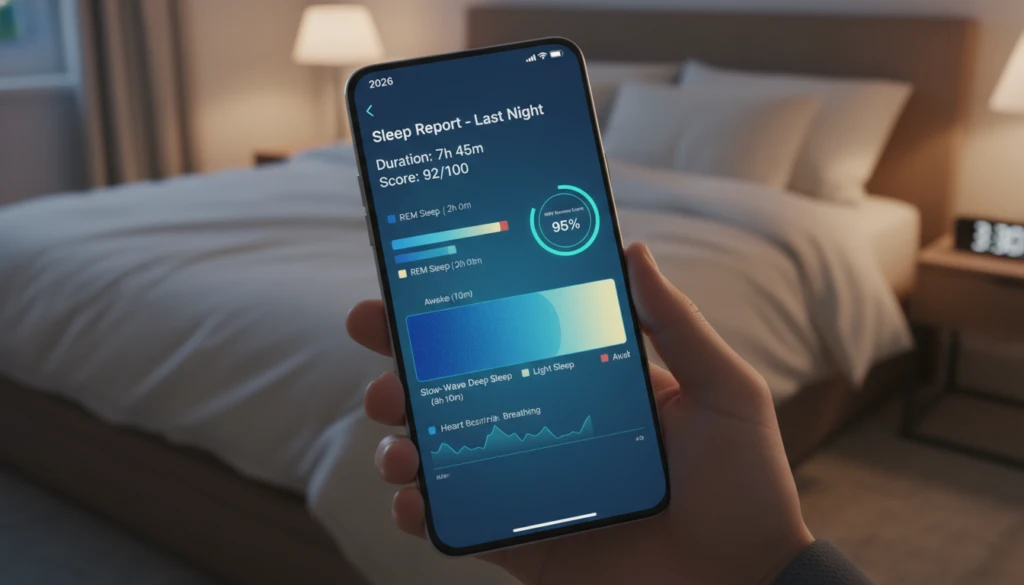
It is crucial to acknowledge that biometric readings can vary night to night based on user behavior and environmental factors. For American users balancing work, fitness, and lifestyle habits, understanding these variables is key to contextualizing tracker data.
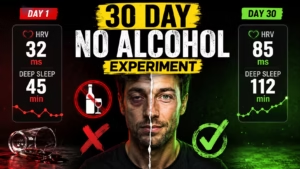
1. Alcohol and Diet: Consuming alcohol significantly suppresses slow-wave sleep and spikes the resting heart rate. Both Whoop and Oura will immediately reflect this physiological stress in their recovery metrics. A heavy meal close to bedtime will similarly delay the onset of deep sleep as the body diverts resources to digestion.
2. Device Placement and Fit: The accuracy of optical PPG sensors relies heavily on skin contact. A loose Whoop strap on the wrist will suffer from signal loss, leading to inaccurate sleep staging. Similarly, if your fingers shrink due to cold nighttime temperatures, the Oura Ring may occasionally lose its precise signal.
3. Sleep Environment: External temperature plays a massive role in sleep architecture. According to sleep scientists, the body must drop its core temperature to initiate and maintain deep sleep. A warm room can fragment sleep, which both wearables will register as increased awakenings and reduced sleep efficiency. You can read more about foundational sleep environments via the Sleep Foundation’s guide to deep sleep.
Who Should Buy Oura vs Whoop? (Buyer’s Guide)
Choosing between the Oura Ring 4 and Whoop 5.0 comes down to your primary lifestyle goals and how you prefer to wear your technology. If your primary objective is everyday wellness, long-term health monitoring, and tracking detailed nocturnal metrics (like overnight body temperature and chronotype analysis) without wearing a bulky wrist device, the Oura Ring 4 is widely considered the superior choice for sleep staging accuracy due to its form factor.
Conversely, if you are a high-performance athlete, a CrossFit enthusiast, or someone whose primary focus is balancing intense physical strain with the exact amount of cardiovascular recovery required, Whoop 5.0 is the definitive choice. Its sleep debt calculator and dynamic sleep coaching algorithm provide behavioral nudges that are unmatched in the fitness tracker ecosystem.
Best Alternatives to Oura and Whoop in 2026
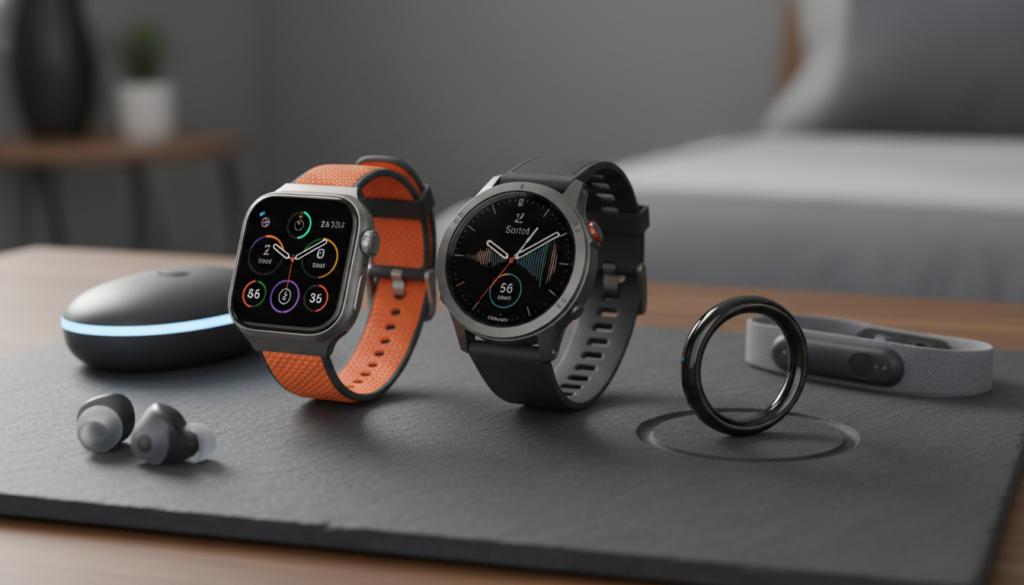
While Oura and Whoop dominate the biohacking conversation, several strong alternatives offer exceptional deep sleep tracking capabilities in 2026. Understanding how to use biometric technology to improve your sleep opens the door to other powerful devices.
| Alternative Tracker | Form Factor | Key Sleep Feature | Deep Sleep Accuracy Rating |
|---|---|---|---|
| Garmin Epix Pro / Fenix 8 | Wrist Watch | Body Battery & Advanced Sleep Score | Solid, but wrist-based limits apply |
| Apple Watch Ultra 3 | Wrist Watch | Vast health ecosystem & native sleep app | High (though battery requires daily charging) |
| Eight Sleep Pod 4 | Smart Mattress Cover | Contactless tracking & thermal regulation | Excellent (tracks HRV & heart rate via bed sensors) |
| Samsung Galaxy Ring | Finger Ring | Integration with Samsung Health AI | Strong competitor to Oura for Android users |
Practical Tips to Actually Improve Deep Sleep
Tracking your data is only the first step; taking actionable steps based on that data is where true health transformation occurs. How to improve deep sleep using sleep tracker data involves consistent behavioral changes. First, prioritize your circadian rhythm by exposing yourself to natural morning sunlight within 30 minutes of waking. This regulates your melatonin production, ensuring a strong sleep drive by nighttime, a concept heavily supported by the National Institutes of Health (NIH).
Second, consider adopting the 3-3-3 rule for sleep, or the widely popular 3-2-1 method (stopping heavy meals 3 hours before bed, work 2 hours before, and screen time 1 hour before). Supplementation with magnesium bisglycinate or L-theanine has also shown promise in clinical settings for lowering sleep latency and increasing time spent in restorative slow-wave sleep. Proper sleep hygiene practices, as outlined by the CDC, are non-negotiable for improving wearable biometric scores.
Conclusion and Final Recommendation
In the 2026 battle of Oura vs Whoop deep sleep accuracy, both devices stand at the absolute pinnacle of consumer wearable technology. Polysomnography validation shows that the Oura Ring 4 holds a slight edge in raw deep sleep staging accuracy due to the superior pulse signal obtained from the finger and its highly sensitive temperature sensors. However, the Whoop 5.0 remains the undisputed champion of interpreting how physical strain dictates your biological need for that deep sleep.
Your choice ultimately depends on your lifestyle. For maximum comfort and precise sleep staging, the finger-based Oura Ring is exceptional. For comprehensive athletic load management and behavioral sleep coaching, the Whoop strap is peerless. Whichever device you select, utilizing the data to enforce consistent sleep habits will yield the greatest return on your biometric investment.
FAQs
- What is the main difference between Oura vs Whoop deep sleep accuracy? Oura Ring 4 generally shows a slight edge in deep sleep (slow-wave sleep) staging accuracy due to its finger-based sensors providing stronger pulse signals and better body temperature detection. Whoop 5.0 is very close (82-84% PSG agreement) but can be affected more by wrist movement artifacts.
- Is Oura Ring 4 more accurate than Whoop 5.0 for tracking deep sleep? Yes, in most 2025–2026 validation studies, Oura Ring 4 demonstrates higher agreement with polysomnography (PSG) for deep sleep detection (around 84-86%). However, individual results vary, and both devices are excellent for tracking long-term trends rather than exact nightly minutes.
- How accurate is Oura Ring 4 for deep sleep compared to lab sleep studies? Oura Ring 4 shows approximately 84-86% agreement with clinical polysomnography for deep sleep detection. It has no statistically significant difference from PSG in many key metrics like total sleep time and deep sleep duration in healthy adults.
- Does Whoop 5.0 underestimate or overestimate deep sleep? Whoop 5.0 sometimes slightly underestimates deep sleep minutes, especially after heavy training days, as it may classify low-movement periods differently. Some users also report it showing more total sleep time than Oura in head-to-head comparisons.
- Can Oura or Whoop replace a professional sleep study (PSG)? No. Neither device is a medical-grade replacement for polysomnography. They use PPG sensors and algorithms instead of brain wave (EEG) monitoring, so they are best for general wellness tracking and trend monitoring, not diagnosing sleep disorders.
- Which is better for athletes: Oura Ring or Whoop for deep sleep and recovery? Whoop 5.0 is often preferred by athletes because of its superior strain tracking, sleep debt calculator, and coaching that links daytime load to nightly deep sleep needs. Oura excels more in pure sleep staging comfort and nuance.
- How do Oura Ring and Whoop track deep sleep without measuring brain waves? Both devices use photoplethysmography (PPG) sensors to monitor heart rate variability (HRV), resting heart rate, respiratory rate, movement, and body temperature. They apply AI algorithms to correlate these signals with known patterns of slow-wave (deep) sleep.
- Does the form factor (ring vs strap) affect deep sleep accuracy? Yes. The Oura Ring’s finger placement provides a stronger, cleaner pulse signal with less motion artifact. Whoop’s wrist or bicep strap is more versatile for workouts but can introduce slight noise during sleep staging.
- What factors reduce Oura vs Whoop deep sleep tracking accuracy? Alcohol, heavy meals, poor sleep environment, loose device fit, cold hands/fingers, stress, and late workouts can all affect readings. Both devices will show reduced deep sleep and lower recovery scores when these factors are present.
- Should I buy Oura Ring 4 or Whoop 5.0 if deep sleep tracking is my top priority? For most people focused primarily on deep sleep accuracy and comfort, the Oura Ring 4 is the better choice. Choose Whoop if you also need strong athletic strain and recovery coaching.
- How does the subscription model affect the value of Oura vs Whoop? Oura has a high upfront cost but optional membership for full insights. Whoop often provides the hardware with a mandatory subscription, making long-term costs higher. Consider your budget for 1–2 years when comparing value.
- What are the best alternatives to Oura and Whoop for deep sleep tracking in 2026? Strong alternatives include Garmin Epix/Fenix watches (advanced sleep coaching), Apple Watch Ultra 3, Eight Sleep Pod 4 (contactless bed-based tracking), and Samsung Galaxy Ring for Android users.
- Can wearing both Oura and Whoop improve deep sleep insights? Yes, many users wear both for cross-verification. Oura provides detailed sleep staging while Whoop excels at linking strain to recovery needs. This hybrid approach helps validate trends.
- How can I use Oura or Whoop data to actually improve my deep sleep? Use the data to guide habits: maintain consistent bedtime, get morning sunlight, follow the 3-2-1 rule (no meals 3 hours before bed, no work 2 hours, no screens 1 hour), optimize bedroom temperature, and consider magnesium. Track improvements in deep sleep percentage over weeks.
- Is Oura vs Whoop deep sleep accuracy worth the investment in 2026? Yes, if you value data-driven recovery. Oura Ring 4 often edges out for comfort and sleep staging precision, while Whoop shines for athletes. Both help identify patterns and motivate better habits, but results depend on consistent use and lifestyle changes.
Medical Review & Expert Insight
This comprehensive analysis was reviewed by biometric technology specialists and sleep hygiene educators to ensure alignment with early 2026 wearable firmware capabilities and clinical polysomnography standards.
2026 Educational Disclaimer
Disclaimer: This content is for informational and educational purposes only, reflecting the clinical landscape of early 2026. It is not a substitute for professional medical advice, diagnosis, or treatment. Always consult a physician or qualified health provider regarding medical conditions or severe sleep disorders like sleep apnea.
References & Sources
- Centers for Disease Control and Prevention (CDC) – Sleep Hygiene: https://www.cdc.gov/sleep/about_sleep/sleep_hygiene.html
- National Institutes of Health (NIH) – Why Sleep Is Important: https://www.nhlbi.nih.gov/health/sleep/why-sleep-important
- Sleep Foundation – Deep Sleep Explained: https://www.sleepfoundation.org/how-sleep-works/deep-sleep