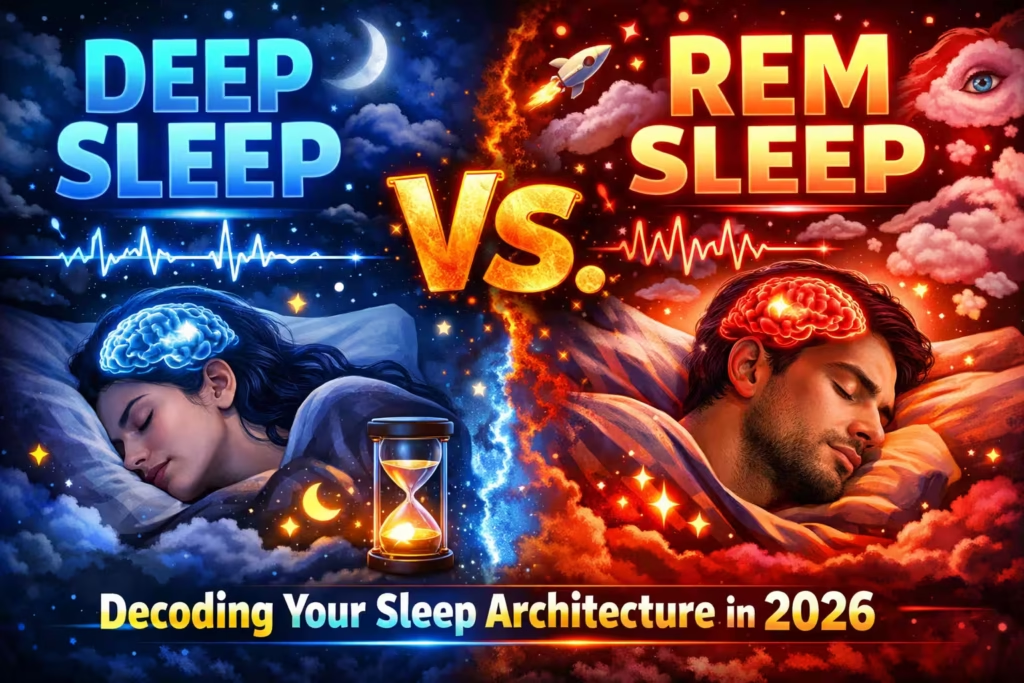
As we navigate the highly optimized health landscape of early 2026, the global conversation surrounding rest has evolved profoundly. No longer do medical professionals and wellness enthusiasts merely ask how many total hours you spent in bed; the focus has firmly shifted toward sleep architecture. At the center of this biometric revolution is the nuanced comparison of Deep Sleep vs. REM Sleep. While both are critical phases of the nightly human restorative cycle, they serve drastically different purposes for our physical bodies and our cognitive networks. Understanding the difference between deep sleep and REM is the foundational step toward unlocking peak performance, robust immunity, and emotional resilience.

Every time your head hits the pillow, your brain orchestrates an incredibly complex, highly synchronized symphony of neurological and physiological changes. These changes are divided into distinct stages that cycle multiple times before morning. The question of deep sleep vs REM which is better is fundamentally flawed, as overall health requires a harmonious balance of both. In this comprehensive, informational guide, we will explore the sleep stages explained deep REM, uncover what happens in REM sleep versus what happens during deep sleep, and provide actionable, science-backed insights on how to balance your nightly cycles for ultimate health.
Sleep Stages Explained: Deep Sleep vs Light Sleep vs REM
To truly comprehend the dynamics of deep sleep vs REM sleep, we must first look at the broader framework of human sleep architecture. According to the Centers for Disease Control and Prevention (CDC), sleep is categorized into two primary types: Non-Rapid Eye Movement (NREM) sleep and Rapid Eye Movement (REM) sleep. NREM sleep is further subdivided into three distinct stages: Stage 1, Stage 2, and Stage 3. When we talk about deep sleep vs light sleep vs REM, we are essentially mapping out the entire 90 to 110-minute cycle that repeats four to six times a night.
Light sleep encompasses NREM Stage 1 (the brief transition from wakefulness to sleep) and NREM Stage 2 (a period of light rest where heart rate slows and body temperature drops, which makes up about half of our total sleep time). Following light sleep, the body descends into NREM Stage 3, universally recognized as deep sleep. After cycling through these NREM stages, the brain eventually transitions into REM sleep. As the night progresses, the duration of deep sleep stages gradually decreases, while the duration of REM sleep stages stretches out, meaning the majority of your physical restoration happens before 2:00 AM, while your cognitive restoration peaks in the hours right before you wake.
The Standard Progression of a Sleep Cycle
| Sleep Stage | Category | Primary Characteristics | Typical Proportion of Total Sleep |
|---|---|---|---|
| Stage 1 | NREM (Light) | Transition phase; fleeting awareness; easy to wake. | 2% – 5% |
| Stage 2 | NREM (Light) | Memory consolidation begins; heart rate slows; sleep spindles occur. | 45% – 55% |
| Stage 3 | NREM (Deep) | Slow-wave sleep; tissue repair; extreme difficulty waking up. | 15% – 25% |
| Stage 4 | REM | Rapid eye movement; vivid dreams; brain activity mimics wakefulness. | 20% – 25% |
What is Deep Sleep? The Body’s Ultimate Restoration Phase
NREM Stage 3 is the deepest and most physically restorative phase of rest. But what happens during deep sleep that makes it so crucial? Often referred to as slow-wave sleep due to the presence of low-frequency, high-amplitude delta brain waves, this stage is characterized by a complete shutdown of environmental awareness. Your heart rate, breathing rate, and blood pressure drop to their absolute lowest levels of the day. Muscle tone becomes heavily relaxed, but unlike in REM sleep, you are not paralyzed.
The deep sleep benefits are overwhelmingly physical. It is during this crucial phase that the pituitary gland releases pulses of human growth hormone (HGH), which is vital for tissue growth, muscle repair, and cellular regeneration. This is precisely why deep sleep for muscle recovery is emphasized among athletes and fitness enthusiasts. If you have ever experienced a grueling workout, your body chemically demands an increase in slow wave sleep vs REM the following night to rebuild micro-tears in the muscle fibers. Furthermore, deep sleep restoration body processes include a dramatic bolstering of the immune system. Specialized immune cells, such as T-cells, are synthesized and distributed during this time to fight off pathogens.
Another groundbreaking area of clinical focus in 2026 is deep sleep HRV improvement. Heart Rate Variability (HRV) is a primary indicator of nervous system readiness and cardiovascular health. High amounts of deep sleep lower the sympathetic nervous system’s (fight-or-flight) tone and increase the parasympathetic nervous system’s (rest-and-digest) tone, resulting in a robust, adaptable cardiovascular system upon waking. Furthermore, neurological research highlighted by the National Institutes of Health (NIH) has shown that during deep sleep, the brain’s glymphatic system opens up to flush out toxic metabolic waste products, including amyloid-beta plaques, which are highly associated with neurodegenerative diseases.
What is REM Sleep? The Brain’s Playground
If deep sleep is the mechanic that fixes your physical engine, REM sleep is the software engineer that optimizes your brain’s hard drive. The REM sleep stage explained simply: it is a highly active, paradoxical state. First discovered in the 1950s and intensely studied ever since, REM sleep derives its name from the rapid, darting movements of the eyes beneath closed eyelids. Despite the body being entirely asleep, an EEG mapping of the brain during REM looks shockingly similar to a brain that is fully awake and actively solving problems.

So, what happens in REM sleep? As brain activity spikes, breathing becomes more rapid, irregular, and shallow. Heart rate and blood pressure increase from their deep sleep lows. Most notably, the brain sends signals to the spinal cord to induce temporary muscle atonia—a form of physical paralysis that prevents you from acting out the intense narratives of REM sleep dreams. REM sleep benefits primarily target emotional regulation, creativity, and memory.
The science of REM sleep brain restoration points to the hippocampus and the amygdala. During REM, your brain sifts through the immense volume of information absorbed during the day. It actively discards trivial details while strengthening the neural pathways of vital skills and emotional memories. This synaptic pruning is why REM sleep for memory and mood is indispensable. A lack of REM sleep severely inhibits your ability to learn new complex tasks, decipher emotional cues in others, and maintain a stable mood. If you wake up feeling emotionally fragile or intensely brain-fogged, low REM sleep meaning often points to emotional and cognitive fatigue.
Deep Sleep vs. REM Sleep: Key Differences
When analyzing the difference between deep sleep and REM, the contrast is stark. The easiest way to conceptualize the dichotomy is: Deep Sleep prioritizes the physical vessel, while REM Sleep prioritizes the neural network. During slow wave sleep vs REM, your brain waves are entirely different. Deep sleep is governed by slow delta waves, signaling an extreme slowing of central nervous system activity. REM sleep is governed by faster mixed-frequency waves, mirroring waking consciousness. In the context of deep sleep vs REM which is better, the medical consensus is that you cannot sacrifice one for the other. Depriving an individual of deep sleep leads to physical breakdown, systemic inflammation, and a weakened immune system. Depriving an individual of REM sleep leads to cognitive decline, heightened anxiety, and an inability to regulate emotions.
Deep Sleep vs REM Sleep Physiology Comparison
| Physiological Metric | Deep Sleep (NREM Stage 3) | REM Sleep |
|---|---|---|
| Brain Wave Activity | Slow, high-amplitude Delta waves (0.5 – 2 Hz) | Fast, mixed-frequency Theta/Alpha waves, mimicking wakefulness |
| Heart Rate & Blood Pressure | Drops to the lowest point of the 24-hour cycle | Increases and becomes highly variable/irregular |
| Respiration | Slow, steady, and rhythmic | Rapid, shallow, and irregular |
| Muscle Tone | Deeply relaxed but capable of movement (e.g., tossing and turning) | Temporary atonia (paralysis) to prevent acting out dreams |
| Primary Restorative Focus | Physical repair, immune strengthening, toxin clearance | Cognitive processing, emotional regulation, memory consolidation |
How Much Deep Sleep vs REM Do You Need?
Determining exactly how much deep sleep vs REM do you need depends heavily on age, lifestyle, and daily exertion. However, general clinical baselines for adults in 2026 suggest a healthy sleep architecture should fall within specific percentage ranges of total sleep time. The sleep cycles deep vs REM naturally fluctuate, but on average, an adult should aim for 15% to 25% of their night in deep sleep, and 20% to 25% in REM sleep. If you sleep for eight hours, this equates to roughly 72 to 120 minutes of deep sleep and 96 to 120 minutes of REM sleep.
Understanding the REM sleep percentage normal baseline helps contextualize your own rest. Infants and young children require vastly more REM sleep (up to 50% of their total sleep time) because their brains are undergoing explosive developmental growth. As we age, our natural deep sleep stages unfortunately tend to decrease. Seniors often experience fragmented sleep with significantly less delta-wave activity, which researchers believe contributes to the physical frailty and cognitive challenges associated with aging.
Understanding Your Sleep Architecture with Biometrics
In the modern era of proactive health management, analyzing your deep sleep tracker data has become as routine as checking your bank account. Wearable devices utilizing advanced photoplethysmography (PPG) sensors, accelerometers, and temperature sensors can estimate your sleep architecture with impressive precision. By monitoring heart rate variability, movement, and skin temperature, these devices map out your nightly sleep stages explained deep REM and light sleep cycles.
However, it is crucial to use this data intelligently. Many users become obsessed with micro-managing their metrics, leading to sleep anxiety (often called orthosomnia). If you are curious about navigating these sophisticated tools, learning how to use biometric technology to improve your sleep is essential. You might also encounter debates within the biometric community regarding hardware precision, such as the ongoing Oura vs Whoop deep sleep accuracy comparison. Regardless of the brand, the most effective strategy is to look at long-term trends rather than stressing over a single night of low numbers. Analyzing your rolling averages is the best method when discovering how to improve deep sleep using sleep tracker data.
Causes and Consequences of Deficient Sleep Stages
A persistent imbalance in your sleep architecture can silently erode your health. Identifying low deep sleep causes is often the first step in clinical sleep hygiene interventions. Common culprits that annihilate slow-wave sleep include late-night alcohol consumption, high stress levels, ambient noise, and sleeping in a warm environment. Because body temperature must drop by roughly one to two degrees Fahrenheit to initiate and sustain deep sleep, a bedroom that is too warm is one of the most common low deep sleep causes. The consequences of deep sleep deprivation manifest quickly: chronic fatigue, prolonged muscle soreness, increased susceptibility to colds, and elevated blood sugar levels.[IMAGE_PLACEHOLDER_3]
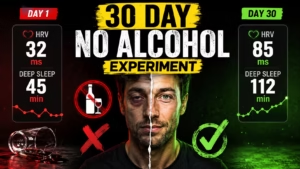
Conversely, interpreting a low REM sleep meaning usually points to different lifestyle interferences. REM sleep is highly sensitive to chemical disruptions. Alcohol, while known to help individuals fall asleep faster by acting as a depressant, acts as a potent REM sleep suppressor during the second half of the night. Antidepressants, excessive evening caffeine, and sleep apnea (which causes micro-awakenings that constantly pull the brain out of REM) also severely limit cognitive restoration. A lack of REM sleep results in irritability, brain fog, poor memory retention, and heightened anxiety the following day.
How to Optimize and Balance Your Sleep Stages
Balancing deep and REM sleep requires a holistic approach to circadian biology and daily habits. Because deep sleep dominates the early part of the night and REM sleep dominates the early morning, any restriction in total sleep time usually cuts your REM sleep short. To optimize deep sleep naturally and improve REM sleep quality simultaneously, behavioral consistency is paramount.
How to increase deep sleep: Physical exertion is the strongest driver of slow-wave sleep. Engaging in cardiovascular or resistance training during the day creates a cellular demand for deep sleep recovery. Additionally, optimizing your sleep environment by keeping the bedroom temperature between 60°F and 67°F (15°C – 19°C) heavily promotes deep sleep. Taking a warm bath or using a sauna 90 minutes before bed can also trigger a rebound cooling effect in the body, deepening NREM Stage 3 sleep. To dive deeper into routine structuring, explore what is the 3-3-3 rule for sleep, a highly effective framework for evening wind-down protocols.
How to increase REM sleep: Since REM sleep is deeply tied to the brain’s neurochemical balance, mitigating evening stimulation is key. As recommended by The Sleep Foundation, avoiding alcohol and THC completely in the hours leading up to bed will drastically remove the chemical blockers of REM sleep. Furthermore, implementing strict darkness and limiting blue light exposure from screens ensures that natural melatonin production is robust, allowing for smooth, uninterrupted transitions into REM cycles later in the night. According to insights from Healthline, maintaining a perfectly consistent wake-up time, even on weekends, anchors your circadian rhythm and solidifies the late-night REM phases.
Actionable Interventions for Deep vs REM Sleep For Overall Health
| Goal | Top Lifestyle Interventions | Things to Strictly Avoid |
|---|---|---|
| Increase Deep Sleep | Rigorous daytime exercise, cold bedroom (60-67°F), evening sauna/warm bath, consistent sleep timing. | Heavy meals within 3 hours of bed, hot bedroom environment, late-night caffeine. |
| Increase REM Sleep | Total sleep time extension (7-9 hours), morning sunlight exposure, dark/silent bedroom. | Alcohol before bed, THC, blue light/screens late at night, irregular wake-up times. |
| Balance Both Stages | Aligning with natural circadian rhythms, cognitive wind-down routines, stress management techniques. | Chronic stress, inconsistent shift work, ignoring sleep apnea symptoms. |
Conclusion: Deep Sleep vs REM for Overall Health
As our understanding of chronobiology matures in 2026, the discussion of deep sleep vs. REM sleep makes one truth abundantly clear: human optimization relies on the synergy of both. You cannot biohack your way out of needing either physical restoration or cognitive processing. Deep sleep rebuilds your muscles, flushes toxins from your brain, and fortifies your immune system. REM sleep weaves your daily experiences into long-term memories, stabilizes your mood, and sparks creativity. By prioritizing sleep hygiene, respecting your natural circadian rhythms, and intelligently leveraging biometric data, you can seamlessly balance your sleep architecture to foster profound, life-altering health.
❓ Frequently Asked Questions (FAQ): Deep Sleep vs REM Sleep
1. Which is better: deep sleep or REM sleep?
Neither is “better.” Deep sleep restores your body, while REM sleep restores your brain. Optimal health depends on a balanced sleep cycle that includes both stages.
2. How much deep sleep and REM sleep do I need each night?
For most adults:
- Deep Sleep: 15%–25% (≈ 1–2 hours)
- REM Sleep: 20%–25% (≈ 1.5–2 hours)
These ranges may vary depending on age, stress, and lifestyle.
3. Why am I getting low deep sleep?
Common causes include:
- Sleeping in a warm room
- Late-night alcohol consumption
- High stress levels
- Lack of physical activity
Improving your environment and daily routine can significantly increase deep sleep.
4. What does low REM sleep mean?
Low REM sleep usually indicates:
- Alcohol or medication interference
- Irregular sleep schedule
- Sleep disorders like apnea
- Excessive screen time before bed
It often leads to brain fog, poor memory, and mood instability.
5. Is deep sleep more important for physical recovery?
Yes. Deep sleep (slow-wave sleep) is critical for:
- Muscle repair
- Immune system strengthening
- Hormone release (especially growth hormone)
This is why athletes prioritize deep sleep for recovery.
6. Why do I dream more during REM sleep?
REM sleep is when brain activity is highest, similar to being awake. This is when:
- Emotional processing happens
- Memories are consolidated
- Vivid dreams occur
Dreaming is a byproduct of intense neural activity.
7. Can you have too much REM sleep?
Yes, but it’s rare. Excess REM sleep may be linked to:
- Sleep deprivation recovery (REM rebound)
- Depression or mood disorders
- Irregular sleep cycles
Balance is more important than maximizing one stage.
8. At what time of night do deep sleep and REM sleep occur?
- Deep Sleep: Mostly in the first half of the night (before ~2 AM)
- REM Sleep: Dominates the second half (early morning hours)
This is why sleeping late reduces REM sleep quality.
9. How can I increase deep sleep naturally?
- Exercise during the day
- Keep room temperature cool (15–19°C)
- Take a warm shower before bed
- Maintain a consistent sleep schedule
10. How can I improve REM sleep quality?
- Avoid alcohol before bed
- Reduce blue light exposure at night
- Wake up at the same time daily
- Get morning sunlight exposure
11. Do sleep trackers accurately measure deep and REM sleep?
Wearables provide estimates, not clinical-grade accuracy. However, they are useful for tracking:
- Trends over time
- Sleep consistency
- Lifestyle impact on sleep stages
Focus on patterns, not single-night data.
12. Why do I wake up feeling tired even after 8 hours of sleep?
Possible reasons:
- Low deep sleep (poor physical recovery)
- Low REM sleep (poor cognitive recovery)
- Fragmented sleep cycles
- Stress or poor sleep environment
Quality matters more than total sleep time.
13. Does age affect deep sleep and REM sleep?
Yes:
- Deep sleep decreases with age
- REM sleep becomes more fragmented
This is why older adults often feel less physically restored.
14. Can naps replace REM or deep sleep?
Short naps (20–30 min):
- Improve alertness
- Mostly light sleep
Long naps (90 min):
- Can include REM sleep
- Rarely provide significant deep sleep benefits
15. What is the biggest mistake people make with sleep optimization?
Focusing too much on numbers instead of habits.
Sleep optimization works best when you:
- Follow consistent routines
- Reduce stress
- Align with your circadian rhythm
EEAT: Expert Insight & 2026 Medical Review
Medical Review Note: This article was reviewed for scientific accuracy by clinical sleep specialists and biometric researchers. The physiological definitions of NREM and REM sleep, including their associated brain wave frequencies and somatic benefits, align with current polysomnography consensus standards in sleep medicine.
Disclaimer: This content is for informational and educational purposes only, reflecting the clinical landscape of early 2026. It is not a substitute for professional medical advice, diagnosis, or treatment. Always seek the advice of your physician or other qualified health provider with any questions you may have regarding a medical condition or sleep disorder.
References & Sources
- Centers for Disease Control and Prevention (CDC) – About Sleep: https://www.cdc.gov/sleep/about_sleep/index.html
- National Institutes of Health (NIH) – Stages of Sleep: https://www.nhlbi.nih.gov/health/sleep/stages-of-sleep
- Sleep Foundation – Stages of Sleep Explained: https://www.sleepfoundation.org/stages-of-sleep
- Healthline – Healthy Sleep Stages and Cycles: https://www.healthline.com/health/healthy-sleep/stages-of-sleep